Design a new facility in 3D—then test it in motion.
Compare layout variants faster than static CAD and validate scale, flow, and constraints before CAPEX is committed.
Why this matters
Typical pains
A clear view of what breaks in the real world—so the model is built for what actually happens.
Static 2D layouts hide flow issues until it’s too late.
Decisions are negotiated by opinion instead of scenarios.
Late changes cause delays and expensive rework.
Outcomes
What improves
A measurable way to evaluate scenario variants and the decisions you will make.
Decision cycle
shorter with 3D alignment
Risk
reduced via scenario variants
Stakeholder clarity
higher via VR/AR reviews
Deliverables
What you get
A decision-ready package: model, scenarios, and an actionable rollout path.
Deliverables
- 3D facility model with zones and assets
- Animated flow narrative for workshops
- Simulation variants for layout and resource options
- VR/AR validation for leadership and operators
Recommended capabilities
Start with the minimum set needed for the outcome, then scale to historical and live data as the use-case matures.
Proof
Case studies
Real scenarios, shown in full under this use case.
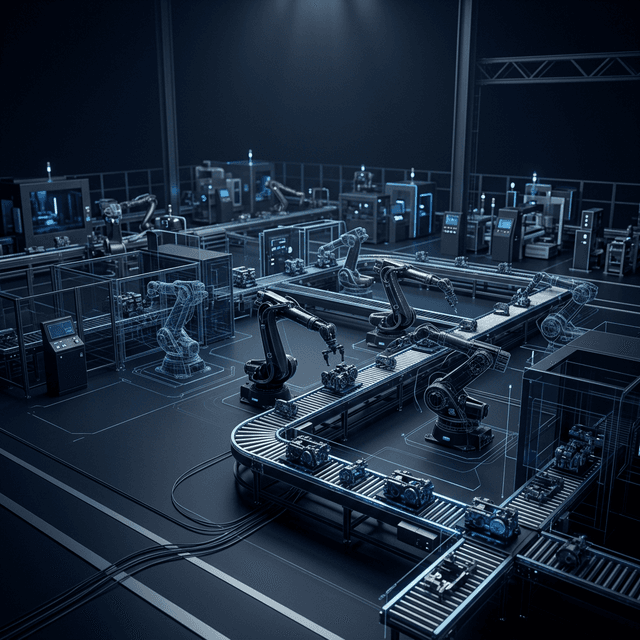
Automotive components (manufacturing + intralogistics)
Expansion plan with step-by-step relocation
Context
A production site expands with a new hall, requiring careful relocation and sequencing to maintain output.
Task
Plan a staged relocation of machines and material flow so production continues without disruption, while validating buffer capacity and intralogistics continuity.
Work
- Built a 3D representation of the facility and added the new hall area.
- Animated process sequences to validate relocation order.
- Modeled material flow with technological times and constraints.
- Simulated variants to find bottlenecks and transport path losses.
Results
- A relocation sequence that preserves planned output.
- Improved final machine layout compared to the initial assumption.
- Identified transport-path extensions as a major source of losses.
Benefits
- Lower risk of disruption during expansion
- Faster decision-making through visual and scenario-based validation
- Better alignment across operations and leadership