Rebuild without breaking operations.
Plan the sequence of moves and validate constraints so you can execute changes with minimal downtime and stable delivery.
Why this matters
Typical pains
A clear view of what breaks in the real world—so the model is built for what actually happens.
Relocations cause cascading issues across flow and buffers.
The real constraint shows up only after changes are live.
Teams lack a shared model of what changes when.
Outcomes
What improves
A measurable way to evaluate scenario variants and the decisions you will make.
Downtime
reduced via stepwise planning
Flow
stabilized with buffer and path validation
Execution
clearer with visual sequencing
Deliverables
What you get
A decision-ready package: model, scenarios, and an actionable rollout path.
Deliverables
- Sequenced relocation plan with constraints
- Animation to communicate steps and dependencies
- Simulation highlighting bottlenecks and transport paths
Recommended capabilities
Start with the minimum set needed for the outcome, then scale to historical and live data as the use-case matures.
Proof
Case studies
Real scenarios, shown in full under this use case.
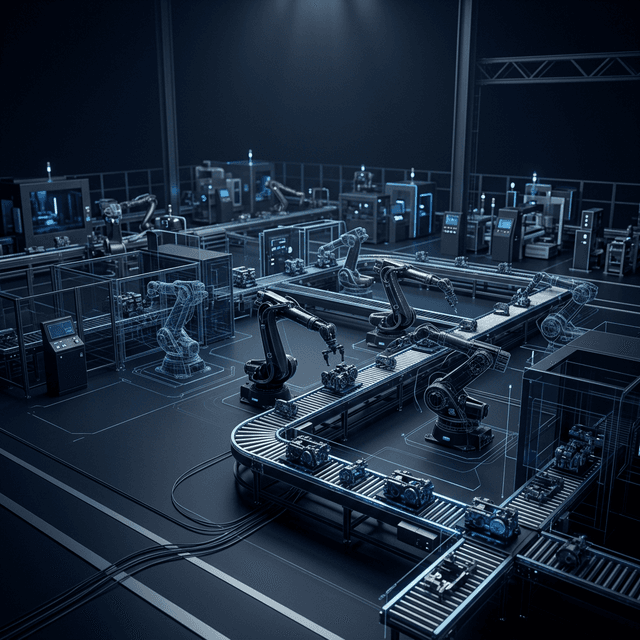
Automotive components (manufacturing + intralogistics)
Expansion plan with step-by-step relocation
Context
A production site expands with a new hall, requiring careful relocation and sequencing to maintain output.
Task
Plan a staged relocation of machines and material flow so production continues without disruption, while validating buffer capacity and intralogistics continuity.
Work
- Built a 3D representation of the facility and added the new hall area.
- Animated process sequences to validate relocation order.
- Modeled material flow with technological times and constraints.
- Simulated variants to find bottlenecks and transport path losses.
Results
- A relocation sequence that preserves planned output.
- Improved final machine layout compared to the initial assumption.
- Identified transport-path extensions as a major source of losses.
Benefits
- Lower risk of disruption during expansion
- Faster decision-making through visual and scenario-based validation
- Better alignment across operations and leadership